
Product family
Heat Sinks and Thermal Plates
Machined, extruded-section and bonded heat sinks in aluminium and copper, with the mounting face flatness controlled.
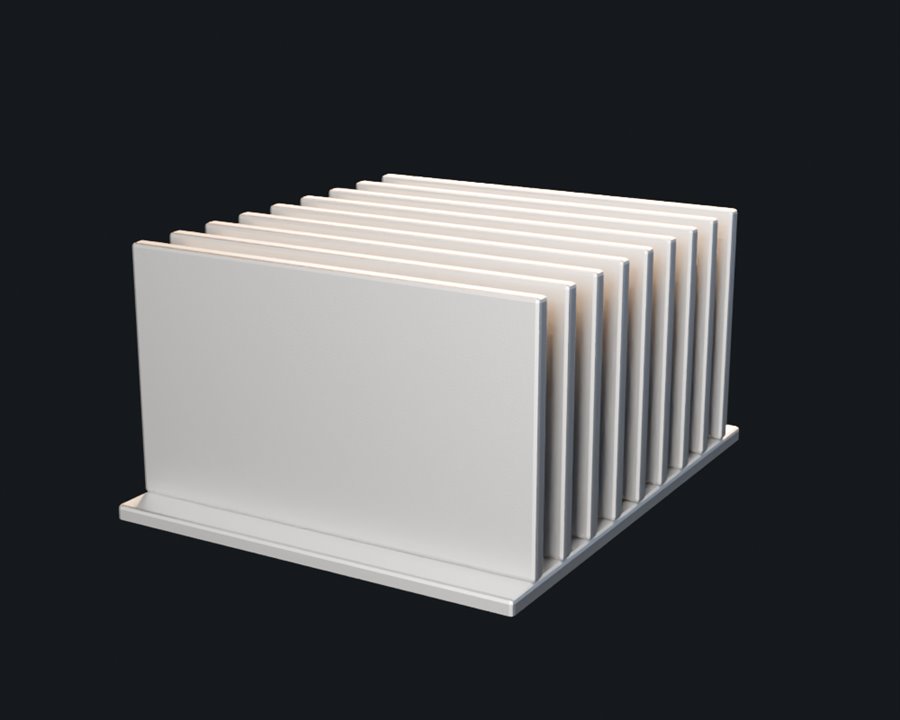
Direct answer: we machine and finish aluminium and copper heat sinks and thermal plates, including CNC machined pin and skived fin designs, extruded section cut to length, and bonded assemblies. The mounting face is held to 0.05 mm flatness, fin geometry to ±0.10 mm, and surfaces are anodised, plated or left as machined.
What we make
- CNC machined pin fin and plate fin heat sinks
- Extruded aluminium section cut, drilled and tapped to length
- Copper heat spreaders and thermal interface plates
- Bonded and soldered fin assemblies
- Heat sinks integrated into a machined housing
- Thermal pads and mounting plates with flatness control
Specification range
| Parameter | Range / value | Note |
|---|---|---|
| Material | 6061, 6063, 1060 aluminium; C11000 copper | 6063 for extruded sections |
| Size | Up to 300 x 300 x 80 mm machined | Larger bonded assemblies on request |
| Mounting face flatness | 0.05 mm | Checked on a surface plate or CMM |
| Fin geometry | ±0.10 mm | Fin thickness 0.8 mm minimum machined |
| Surface finish | Ra 1.6 µm machined | Ra 0.8 µm on thermal contact faces |
| Finish | Anodising 5 – 25 µm, nickel plating, chromate conversion, bare | Anodising adds 5 – 25 µm per surface |
What actually limits heat sink performance
A heat sink is usually limited by the thermal interface and the mounting pressure, not by the fin count. A mounting face that is not flat leaves an air gap that dominates the thermal resistance, and over-tightened screws bow the base. That is why flatness and hole position are specified and inspected on these parts rather than left to the general tolerance.
Design rules
- Give the heat load, the allowable temperature rise and the airflow – fin pitch follows from airflow, not from appearance.
- Specify the flatness of the mounting face, and the surface roughness if a thermal pad or grease is used.
- Position mounting holes to avoid bowing the base when the screws are tightened.
- Allow for anodising thickness on the mounting face if the part must sit flat on a component.
- Keep machined fin thickness at 0.8 mm or more; thinner fins need skiving and are quoted separately.
Frequently asked questions
Can you make skived or bonded fin heat sinks?
Machined pin and plate fins are made in house. Skived fins and bonded stacks are quoted with a partner process and stated clearly in the quotation, including the lead time difference.
What flatness can you hold on the mounting face?
0.05 mm over the mounting area is standard, measured on a surface plate or CMM. Tighter values need lapping and are quoted separately.
Does anodising affect the thermal path?
Yes – anodising adds 5 to 25 µm of aluminium oxide on every surface, which is a poor conductor compared with metal. If the mounting face is a thermal path, it is normally masked before anodising.
Send the heat sink drawing and the thermal requirement
Heat load, airflow, mounting method and flatness decide the design. Send them with the drawing for a route and a price.