Product family
Copper Busbars
Flat, stepped, laminated and insulated busbars in C11000 and C18150 copper, with the joint area plated and the rest left bare or masked.
Direct answer: we make copper busbars from 0.5 to 6 mm sheet in C11000 (ETP) or C18150 (chromium zirconium) copper, cut and bent to ±0.05 mm on joint faces, then silver, nickel or tin plated from 1 to 5 µm on the contact area. Busbars are supplied bare, heat-shrink insulated, powder coated or laminated, from single prototypes to tens of thousands per year.
Types we make
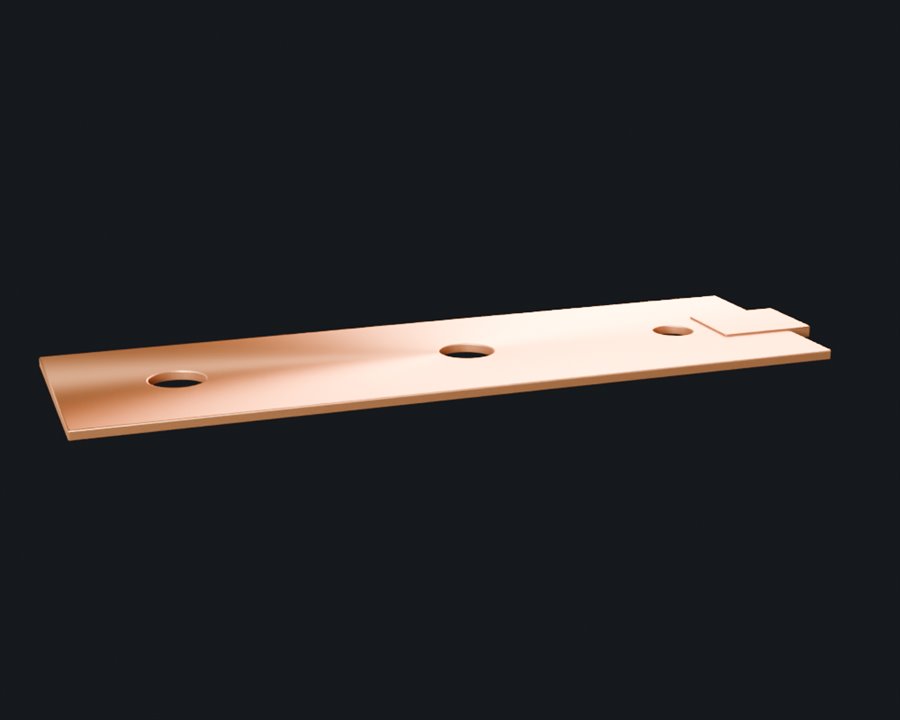
- Flat busbars with punched or drilled holes and deburred edges
- Stepped and offset busbars with two or more bends at controlled positions
- Laminated busbars with insulating film between layers
- Insulated busbars with heat shrink or powder coating, joints masked
- Busbar assemblies with terminals, standoffs or fuses fitted
- Flexible connections from stacked copper foil where movement must be absorbed
Specification range
| Parameter | Range / value | Note |
|---|---|---|
| Material | C11000, C18150, C2680 | C18150 when strength after bending is needed |
| Thickness | 0.5 – 6 mm | Above 6 mm quoted as plate machining |
| Length | Up to 3000 mm | Longer parts quoted as two-piece assemblies |
| Profile tolerance | ±0.10 mm | ±0.05 mm on joint faces |
| Bend position | ±0.10 mm, angle ±0.5° | Bend radius 1 x thickness minimum |
| Plating | Silver 1 – 5 µm, nickel 3 – 10 µm, tin 1 – 10 µm | Nickel barrier under silver where specified |
| Insulation | Heat shrink, powder coat, insulating film | Wall thickness agreed per drawing |
| Marking | Laser marking or stamping | Must survive plating and cleaning |
Process route
1. Cutting
Fibre laser cutting for prototypes and low volume, stamping for serial volume – the route is chosen by quantity and hole pattern.
2. Forming
CNC bending with bend position controlled from the drawing datum, not from the sheet edge.
3. Deburring and cleaning
Edges deburred before plating so the contact surface is flat and the insulation is not punctured.
4. Plating and masking
Silver, nickel or tin plating with the non-contact area masked where the drawing requires it.
5. Insulation
Heat shrink, powder coat or film applied after plating; joints kept exposed.
6. Inspection
Dimensional report on hole pattern, bend position and joint face flatness, plus plating thickness per batch.
Design rules
- Define the current path and the contact area – plating is only needed where current crosses a joint.
- Give the flatness of joint faces explicitly; a general tolerance does not control it and a bowed busbar raises contact resistance.
- Keep hole-to-bend distance at least 2.5 x thickness plus the bend radius to avoid distortion of the hole.
- Allow for plating thickness in press-fit and threaded features, or specify masking.
- State the burr limit on the contact face – burrs concentrate current and can puncture insulation film.
- For laminated busbars, give the layer count, the dielectric requirement and the creepage distance.
Frequently asked questions
Do you make busbars from copper bar as well as sheet?
Yes – flat busbars are normally cut from sheet, and parts with a machined profile or a thickness above 6 mm are machined from bar or plate. The quotation states which route is used, because it changes both price and lead time.
Can you insulate only part of the busbar?
Yes. Heat shrink, powder coating and insulating film are applied with the joint area masked, so the contact surface stays conductive while the rest is insulated. The mask line is defined on the drawing.
What is the usual lead time?
Prototype busbars in 7 to 15 working days after drawing approval, serial production in 3 to 4 weeks. Plating and insulation add the longer end of that range.
Do you test resistance?
Resistance or continuity testing is available with the method, sample size and acceptance limit agreed before production, so the result is comparable with your incoming inspection.
Send the busbar drawing with the joint requirement
State the material, the plating, the insulation, the resistance limit and the annual volume so the quotation matches the part.