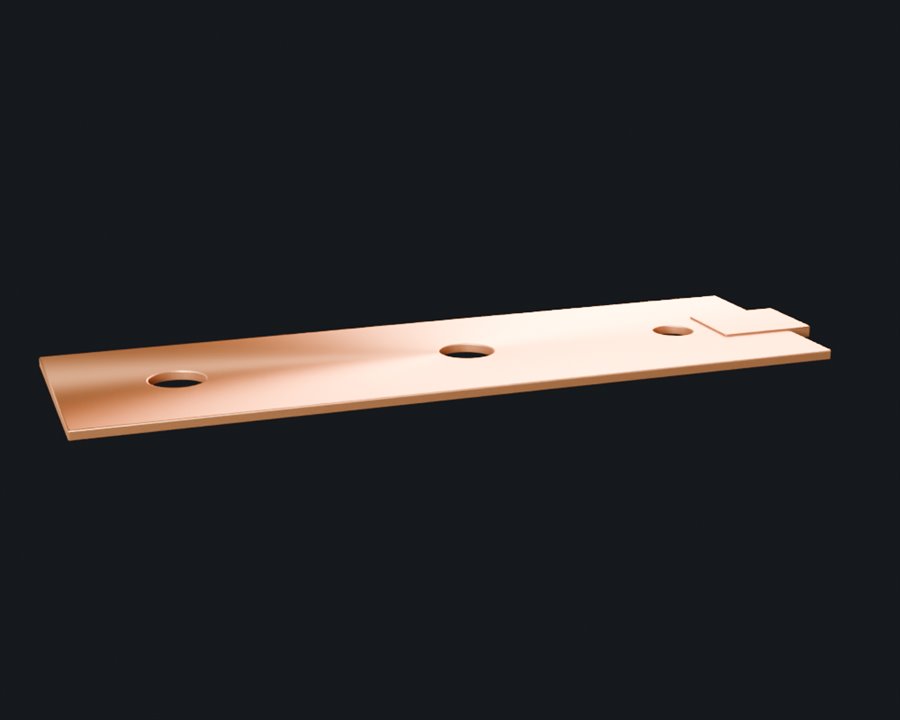
Case study
Module busbar: from laser-cut prototype to stamped production
A battery module busbar changes process three times between one prototype and a production programme. Each change moves the price, the lead time and the inspection plan. This is where the switches happen and what to put on the drawing at each stage.
The figures describe the representative case discussed in this note, not a specific customer order.
| Volume | 1 piece prototype, then 500–10,000 on a compound die, above that progressive |
| Material | C11000 (ETP) copper, 2 mm in the prototype |
| Route | Laser cut and CNC bent, moving to stamping as volume rises |
| Control that decides it | Flatness and plating on the joint face, not the cut quality |
The situation
A module busbar carrying 200-400 A between cells has three jobs: carry current without heating the joint, locate mechanically on the module, and survive the plating and assembly process. In a prototype the design is still moving, so the shortest route to a part is laser cut from 2 mm C11000, bent once, joint faces left bare.
Two problems appear at that stage: bend position is only held to ±0.10 mm, and any plating on the contact area has to be masked by hand. Both are acceptable for ten pieces and expensive for ten thousand.
What changes with volume
The crossover is not fixed – it moves with part size and tolerance. That is why we quote tooling and unit price as separate lines: you decide when the die is worth it.
| Stage | Process | What it fixes | What it costs |
|---|---|---|---|
| Prototype (1-500 pcs) | Laser cut + CNC bend | No tooling, design still changeable | High unit price, ±0.10 mm on formed features |
| Pilot (500-10,000) | Compound die + bend | Unit price drops, bend position tightens | Tooling paid up front, changes cost money |
| Production (10,000+) | Progressive die | Lowest unit price, repeatable burr and flatness | Highest tooling, design locked |
The feature that actually decides yield
- Joint face flatness – a busbar conducts through the contact area. If that face is bowed, the contact is a line and the joint heats up. Specify flatness on the joint face, not on the whole part.
- Plating and masking – silver at 1-5 µm on the contact area, bare elsewhere. Every masked area is manual work; a single continuous plated window is cheaper than four separate pads.
- Bend position – the bend is referenced from the drawing datum, not from the sheet edge. If the datum is the outline, every upstream cut tolerance lands on the bend.
- Hole-to-bend distance – keep it at 2.5x thickness plus the bend radius, otherwise the hole deforms and the bolt will not seat.
What we would change in the drawing
- State the alloy and temper: C11000 for formed joints, C18150 where strength after bending matters.
- Draw the plated area as a closed boundary and name the thickness, instead of writing “plated”.
- Put the flatness call on the joint face, with the measurement method and whether it is checked before or after plating.
- Give the annual volume as well as the order quantity – the process choice depends on both.
Send the busbar and the annual volume
You get the tooling split out from the unit price, and a DFM note on the joint face and masking before anything is cut.
Frequently asked questions
- Can you make both bare and plated busbars in one order? — Yes, but treat them as two part numbers: the plated parts need masking and a separate inspection step, so the price per piece is not the same.
- What tolerance can you hold on a laser-cut busbar? — ±0.10 mm on cut profiles and bend position as standard; ±0.05 mm is achievable on short flanges with effort. Hole position can be tightened with a jig.
- Do you laminate busbars? — Yes – laminated stacks with insulating film between layers, up to the layer count and dielectric requirement you specify.
Related
- Copper busbars — The part family this note is about.
- Design guide: copper busbar — Thickness, plating and joint faces before you draw.
Send drawings. Get a reviewed quote.
One business day response, engineering comments included. No account needed.